
This site is reader-supported. When you buy through our links, we sometimes earn a commission from the provider — at no extra cost to you. In fact, you'll often get an exclusive discount. These partnerships fund our independent work, but never shape our conclusions. Learn more
Heading to Japan soon? Then a reliable eSIM is essential. In a country where signs can be hard to decipher and the language barrier is real, a working internet connection isn't a luxury, it's a basic necessity. But how do you stay connected without racking up a massive roaming bill?
With over 200 eSIM providers promising fast, reliable coverage, and some even "unlimited data", it's hard to know what to believe. Most perform well, but I found big differences in price and quality, and there are one or two I'd personally avoid.
I bought and tested 15 of the most popular eSIMs myself. There's no single best eSIM for everyone, but there are three clear winners per category:
- Best for heavy users (unlimited): Sim Local
- Best all-rounder (value and coverage): Ubigi
- Best for the wallet (budget): Pingwe
Read on for my honest, hands-on review, or jump straight to our Japan eSIM comparison.
Short on time? Use code FYESIM10 for 10% off my all-round top pick Ubigi, with premium coverage on both Docomo and au.
How to Choose the Right eSIM for Japan?

Looking for a Japan eSIM? The best eSIM depends entirely on your specific needs. Here are my top tips to avoid common pitfalls:
- Check your home data usage: Most travellers use around 10 GB per month in daily life. Check your latest mobile bill first. There's usually no need to overpay for expensive "unlimited" plans.
- Network matters: In big cities like Tokyo, any network works. For rural areas or hiking, I strongly recommend an eSIM on Docomo (preferably) or at least au for reliable coverage.
- The "unlimited" reality: Be sceptical. If a provider doesn't clearly state a daily limit (for example "3 GB per day"), assume you'll be throttled quickly. Demand transparency.
- Hotspotting: Need to share data with family, or connect your laptop? Some (unlimited) plans strictly block or limit this. Check the terms carefully before buying.
- Ignore generic ratings: A five-star general score means little for Japan performance. Rely on specific, hands-on local tests.
- Don't just look at speed: A high download speed is useless if there's a big delay on the line. Some providers route your data around the world (for example via Europe) before it reaches your phone. This makes Google Maps feel slow and calls stutter, even on 5G.
Finally, don't forget to check compatibility. Most smartphones released from 2019 onwards are supported, but make sure your device isn't carrier-locked. While this is rare nowadays, it's always worth double-checking.
How much data do you actually need? Use our data calculator to estimate what you'll really use. Want to compare prices? Browse all 45+ providers via our Japan eSIM comparison tool.
Ubigi: Best overall
Ubigi is my recommendation as the best choice for most travellers, particularly for data plans up to 20 GB.
Use discount code FYESIM10 for 10% off your Ubigi eSIM.
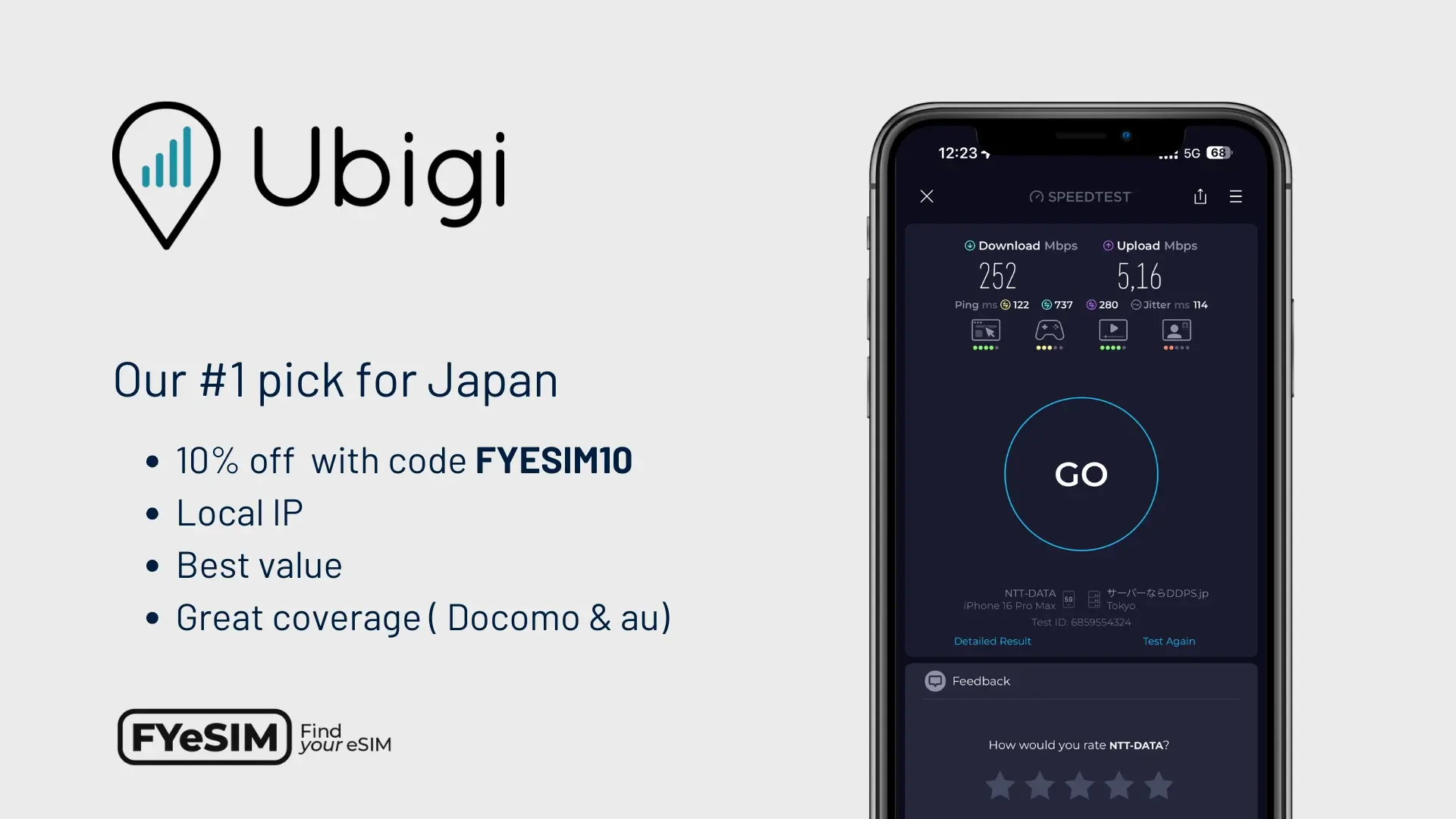
As part of the NTT Docomo Group, Ubigi offers premium coverage on both NTT Docomo and KDDI (au). Think of Docomo as the premium, top-tier network in Japan; while cheaper alternatives often rely on SoftBank (which can struggle in remote areas), this dual-network access is ideal for hiking the Nakasendo trail or venturing into the Japanese Alps.
I clocked impressive speeds of 252 Mbps. Your data travels via nearby Korea, which causes a tiny delay, but the connection stays much faster than providers routing via Europe, China or Singapore. You also get a local IP address, ensuring smooth access to local services without geo-blocks.
Ubigi: Pros
- Premium coverage on both Docomo and au
- Excellent value with a user-friendly app and instant top-ups
- Hotspot your entire data allowance to other devices
- Local IP address for smooth access to Japanese services
Ubigi: Cons
- Data routes via Korea, causing a slight delay in video calls
- No phone number included (data only)
Featured Ubigi plans for Japan
-
 Ubigi JAPANJapan only5GData3 GBValidity15 days€7.50€6.75€2.25/GB€7.50€2.50/GB−10% with code
 - Ubigi JAPANJapan only5GData10 GBValidity7 days€14.00€12.60€1.26/GB€14.00€1.40/GB−10% with code
Sim Local: Best Unlimited Data
Sim Local was my personal favourite during my stay in Japan. That's notable, because I usually avoid "unlimited" plans due to hidden throttling and a lack of transparency. But Sim Local surprised me: thanks to a direct partnership with au, it offers a transparent 10 GB per day allowance, shielding you from the hidden caps found elsewhere.
Use discount code FYESIM15 for 15% off your Sim Local eSIM.
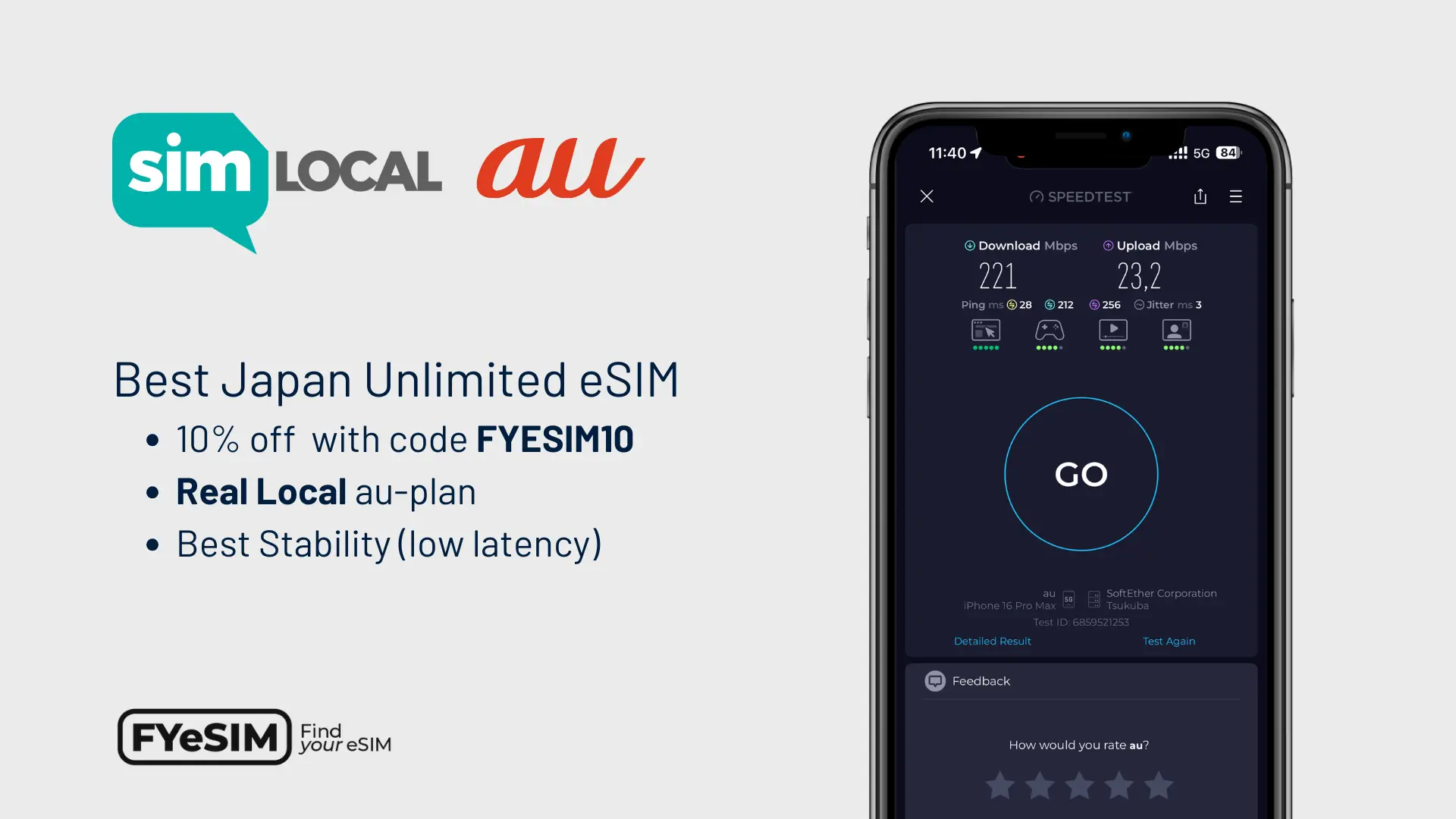
Crucially, Sim Local is truly local. While every eSIM connects to Japanese towers, most competitors route your roaming data all the way through Europe or China (causing lag or even blocked socials). Sim Local keeps your traffic directly within Japan for a much faster, snappier experience.
It uses the au/KDDI network, widely considered the second-best network in Japan and perfect for 99% of travellers. Check coverage maps if you plan to venture into extremely remote, mountainous areas. The value is spot on, and I'd recommend this plan even if you just want a worry-free holiday without strictly needing unlimited data.
Sim Local: Pros
- Transparent 10 GB per day high-speed allowance
- Direct au partnership with a local Japanese IP and low latency
- Truly local routing for a fast, snappy connection
- Fast human support (response within 12 minutes in my test)
Sim Local: Cons
- Hotspot and tethering limited to around 3 GB
- Runs on au rather than Docomo, so check coverage for very remote areas
Featured Sim Local plans for Japan
-
 Sim Local AU - Japan eSIMJapan onlyJapan only
This eSIM is for personal use. It includes 10GB/DAY at full speed. After this, speeds are reduced until the next daily reset. Check the Sim Local website for the full Fair Usage Policy.
Fair-use policy based on information we automatically receive from the provider every 24 hours.
What's this?
Unlimited plans almost always apply a fair-use or data policy: speeds may be reduced after a high-speed allowance. Sometimes providers also throttle the speed from the start. Check the provider's terms before buying. We recommend caution if a provider doesn't clearly communicate its policy during checkout.
DataUnlimitedValidity7 days€16.25€14.63€16.25−15% with code - Sim Local AU - Japan eSIMJapan onlyJapan only
This eSIM is for personal use. It includes 10GB/DAY at full speed. After this, speeds are reduced until the next daily reset. Check the Sim Local website for the full Fair Usage Policy.
Fair-use policy based on information we automatically receive from the provider every 24 hours.
What's this?
Unlimited plans almost always apply a fair-use or data policy: speeds may be reduced after a high-speed allowance. Sometimes providers also throttle the speed from the start. Check the provider's terms before buying. We recommend caution if a provider doesn't clearly communicate its policy during checkout.
DataUnlimitedValidity15 days€33.50€30.15€33.50−15% with code
Pingwe: Best on a budget
Just want simple data connectivity without too many demands? Then Pingwe (based in Amsterdam) is the perfect solution.
In my test, Pingwe was clearly the "best of the rest", but at a much lower price point. It's a strictly basic provider: there's no app to check your usage, so you monitor data via your phone settings. At this price, though, it's hard to find a comparable connection.
Pingwe connects via Hong Kong, so video calls might stutter occasionally, but general use (browsing, Google Maps) was smooth. One surprise finding: Hong Kong IP addresses are normally blocked by apps like TikTok and ChatGPT, but they worked fine during my test. I can't promise this will always be the case, but it was a notable observation.
Pingwe: Pros
- Unbeatable budget option for the lowest price
- Reliable, no-nonsense data-only service that just works
- Hong Kong IP worked with TikTok and ChatGPT in my test
Pingwe: Cons
- No app (check phone settings for data usage)
- Hong Kong routing can cause a slight delay in video calls
Featured Pingwe plans for Japan
-
 Pingwe JapanJapan onlyData10 GBValidity30 days€7.51€7.14€0.71/GB€7.51€0.75/GB−5% with code
 - Pingwe JapanJapan onlyData20 GBValidity30 days€14.09€13.39€0.67/GB€14.09€0.70/GB−5% with code
Unlimited data eSIM for Japan

I tested several "unlimited" plans in Japan. Sim Local was the clear winner, though Truely, Ubigi and IIJ (via iRoamly) also performed well. Unfortunately, both Holafly and Yesim disappointed.
Note: unlimited always comes with a fair use policy. Limits and network partners can change.
Top contenders
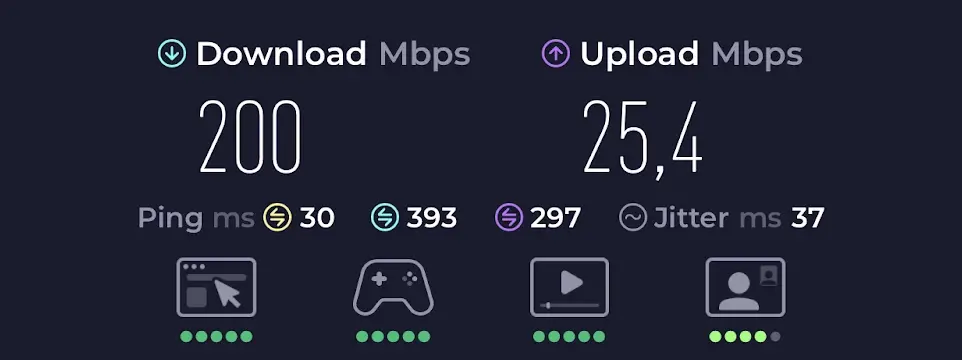
- Truely: The best alternative. It features a local IP address, a generous 5 GB per day high-speed limit, and download speeds reaching 200 Mbps.
- Ubigi: Excellent connection quality and a local IP. Read more.
- iRoamly (IIJ): A strong budget option running on the Docomo network, though it lacks 5G access. iRoamly claims genuinely unlimited data with no hard cap; in my tests I used 6 GB with no noticeable throttling. Note: this applies specifically to iRoamly's local IP offering, not their standard unlimited plan.
The middle ground
- Saily (5 GB per day via Hong Kong) and Jetpac (3 GB per day via Singapore): Both offer decent transparency but rely on non-local routing. Saily lets you select an IP address from over 100 countries. Jetpac offers perks like lounge access during flight delays, plus free Google Maps and WhatsApp even after your data allowance runs out.
- Firsty: Offers flexible daily plans, but suffers from performance hiccups due to inefficient routing via Mauritius.
Unlimited plans with real limits
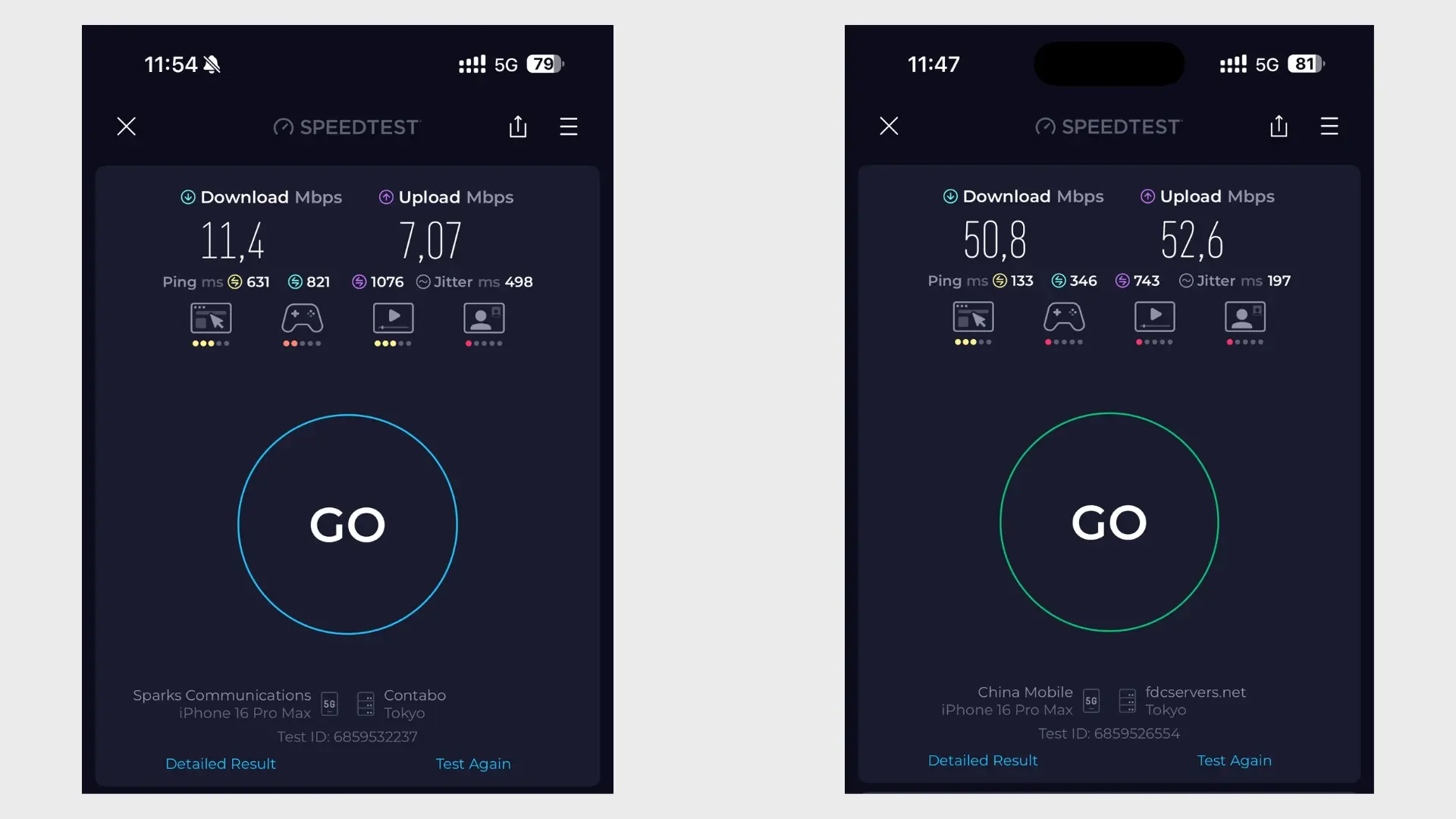
- Holafly: Their FAQ states that if usage exceeds 90 GB per month, speeds may be temporarily reduced to as low as 256 kbps (256 to 1024 kbps), which would make even basic browsing and messaging unworkable. Spread evenly across 30 days, that's roughly 3 GB per day. In my tests, my IP alternated between Shanghai (China) and Singapore, and when the Chinese IP was active I had occasional access issues with some services. Holafly peaked at just 50.8 Mbps, and the higher latency made it less suitable for video calls.
- Yesim: The biggest disappointment for me personally. Speeds peaked at 11.3 Mbps with a remote breakout via Europe, which made browsing feel sluggish. In a support chat (November 2025), Yesim suggested their "unlimited" plans may not be suitable for heavy data use.
Holafly will likely work for most travellers who aren't planning data-heavy tasks. But given the price, the restricted hotspotting, capped speeds and fair use policy, I find it difficult to classify it as truly "unlimited". Sim Local (my top pick) was transparent about its 10 GB daily allowance and performed flawlessly, while the pricier "premium" plans hid significant pitfalls that are invisible at checkout. Always check the fine print; if the terms are vague or hidden, look elsewhere.
All eSIM test results in Japan
I ran a strict benchmark at Shiba Park in Tokyo on 30 November 2025 (noon), using an iPhone 16 Pro. This open-air setting let every provider record its peak performance.
Key takeaways:
- Congestion is real: In crowded spots like Shibuya Crossing, speeds dropped significantly. Sim Local slowed to 10 Mbps, while Yesim and Holafly ground to a virtual halt.
- Expectations: The figures below represent peak speeds. Expect lower performance in busy city centres due to network traffic.
- Verdict: Price aside, most providers are excellent for 90% of travellers. The only outlier was Yesim's "unlimited" plan, which underperformed in my tests.
Don't stare blindly at download figures. For 99% of travellers, 50 Mbps is ample and easily handles two Ultra HD streams. Instead, pay attention to stability: a high download speed is of little value if your data is routed via a server halfway across the world, making the connection feel sluggish.
Note: Providers may change their partners, infrastructure and technical setups at any time and without notice. If a local IP address is essential for your use case, always verify this directly with the provider beforehand. These tests represent a snapshot in time; while professionally executed, they reflect my personal experience at the time of testing.
| Provider | Speeds (Mbps) | Stability | Routing |
|---|---|---|---|
| Sim Local | 221 ↓ / 23.2 ↑ | Excellent. Great for browsing, VoIP, video and remote work. | Japan (local Tokyo IP, au) |
| Airalo | 183 ↓ / 25.2 ↑ | Excellent. Great for browsing, VoIP, video and remote work. | Japan (local Tokyo IP, Webbing-usa) |
| Voye Global | 186 ↓ / 24.6 ↑ | Excellent. Great for browsing, VoIP, video and remote work. | Japan (local Tokyo IP, Webbing-usa) |
| Truely | 200 ↓ / 25.4 ↑ | Excellent. Great for browsing, VoIP, video and remote work. | Japan (local Tokyo IP, Webbing-usa) |
| IIJ (via iRoamly) | 79.1 ↓ / 5.61 ↑ | Good. Browsing and streaming work fine, HD video calls generally smooth. | Japan (local IP via Osaka, IIJmio LTE) |
| Ubigi | 252 ↓ / 5.16 ↑ | Fair to good. Fine for browsing and streaming, some delay in video calls. | Japan IP assigned, breakout via Seoul |
| Eskimo | 307 ↓ / 32.6 ↑ | Good. Great for browsing and streaming, some lag in VoIP or live meetings. | Singapore (remote routing) |
| Jetpac | 167 ↓ / 54.1 ↑ | Good. Browsing and video fine, but clear lag in VoIP and live meetings. | Singapore (remote routing, Telna) |
| Holafly | 50.8 ↓ / 52.6 ↑ | Fair. OK for casual browsing and socials, video calls stuttered. | Singapore and Shanghai, China (remote routing) |
| Pingwe | 142 ↓ / 57.9 ↑ | Fair to good. Decent for normal use; video calls show some delay. | Hong Kong (remote routing) |
| Saily | 127 ↓ / 21.6 ↑ | Fair. Decent for normal use (browsing, socials). Video calls might stutter a bit. | Hong Kong (remote routing) |
| Esimatic | 85.2 ↓ / 5.39 ↑ | High delay; video calls are unstable and often laggy. | Mauritius (remote routing) |
| Firsty | 231 ↓ / 4.33 ↑ | Decent for browsing and socials; VoIP works with some delay but video calls lag. | Mauritius (remote routing) |
| Yesim | 11.3 ↓ / 5.93 ↑ | Very poor. Browsing feels sluggish; video calls are basically unusable. | London/Europe (remote routing) |
I ran a strict benchmark at Shiba Park in Tokyo on 30 November 2025 (noon), using an iPhone 16 Pro. This open-air setting let every provider record its peak performance, so expect lower speeds in busy city centres. Providers may change their partners, infrastructure and routing at any time, so verify a local IP directly with the provider if it is essential for you.
Local networks in Japan
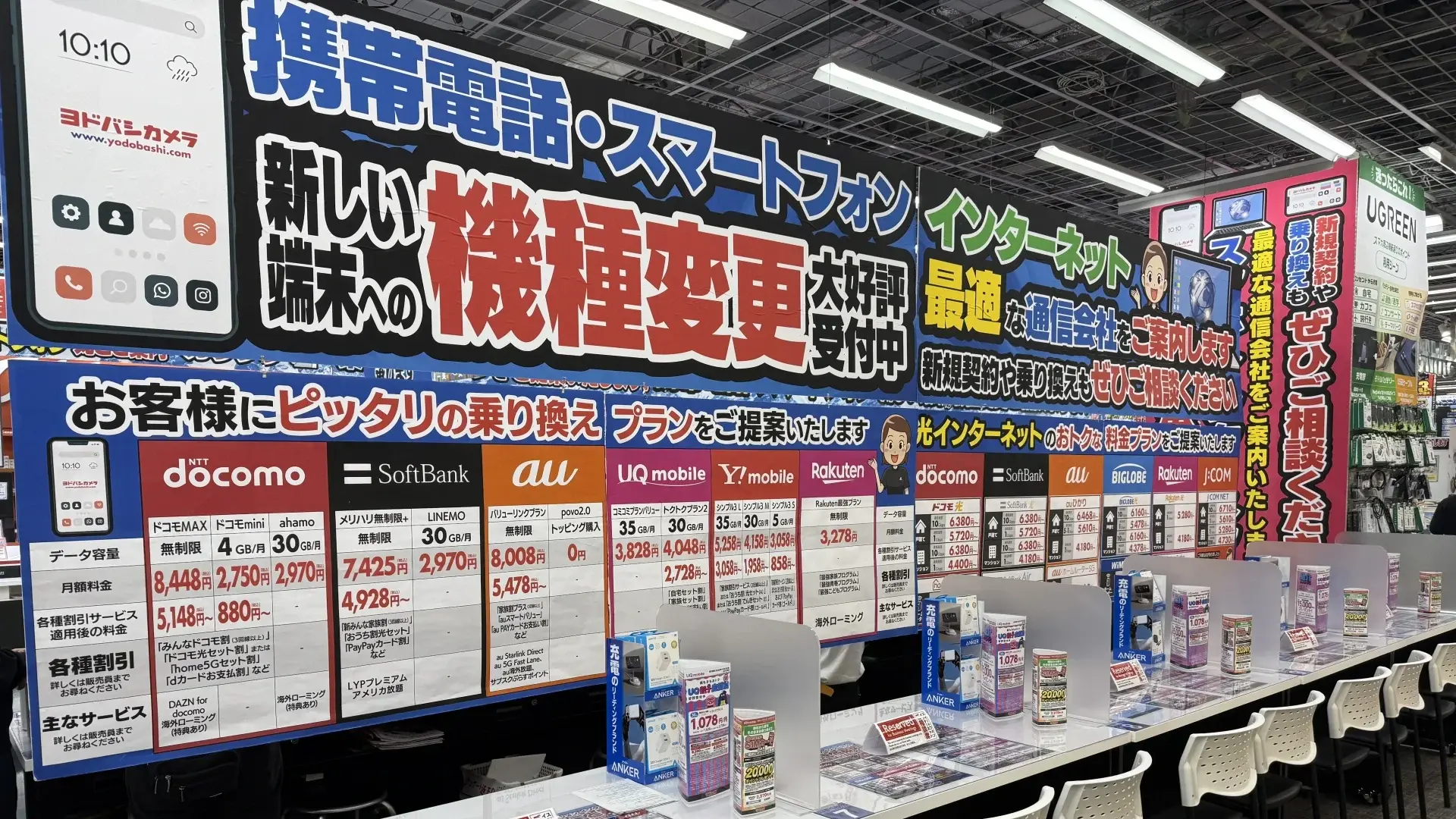
These are the major mobile networks in Japan:
- NTT Docomo
- KDDI (au)
- SoftBank
- Rakuten Mobile
While 5G is widely available in urban areas and tourist hubs, 4G/LTE provides the most extensive geographic coverage across the islands.
NTT Docomo is the premium network, with the most extensive and reliable coverage, especially if you venture inland or to remote areas. KDDI (au) and SoftBank are strong competitors with excellent high-speed data in the urban tourist hubs. Ubigi users benefit from access to both Docomo and au. You can read more about current performance in the OpenSignal Mobile Network Experience report.
However, 5G access and speeds depend entirely on your eSIM's specific (roaming) agreements. In my test, Airalo, Sim Local, Ubigi and Truely made the best use of Japan's powerful networks.
Final thoughts
Roaming costs can add up quickly in Japan. For most travellers, a travel eSIM is the perfect solution to avoid bill shock.
The Japanese mobile infrastructure (Docomo and au) is incredibly dense and reliable, but my tests showed that routing makes a massive difference. Top providers offered snappy, local connections with speeds exceeding 200 Mbps, while others felt sluggish due to data being routed via Europe or China.
To sum things up, here are my top picks for mobile data in Japan, based on my tests:
- Sim Local (best for unlimited data and a local IP)
- Ubigi (best all-rounder, top coverage and reliability)
- Pingwe (best budget option)
Or compare 45+ providers yourself via our Japan eSIM comparison. Sort it out before you fly and you're online the moment you land.

Founder of Find Your eSIM. An avid traveller with roots in telecom, he works fully remote and has been hands-on testing travel eSIMs since 2023. He only recommends providers he'd use himself.