
This site is reader-supported. When you buy through our links, we sometimes earn a commission from the provider — at no extra cost to you. In fact, you'll often get an exclusive discount. These partnerships fund our independent work, but never shape our conclusions. Learn more
Heading off to South Korea soon? It's wise to sort out mobile data before you go. While English will get you by in hotels, the language barrier is very real in restaurants, taxis and out on the street. A solid translation app and Naver Maps (Google Maps doesn't work well in Korea) are indispensable.
With hundreds of eSIM providers promising "fast, reliable coverage" and some even "unlimited data", it's hard to know what to believe. That's why I tested 11 popular providers for you. The reality? Most perform well, but I found huge differences in price and quality, and the policies on "unlimited" plans vary widely.
Two providers stood out for me in terms of experience, and there are also a few solid budget options if you only plan to browse and use WhatsApp.
Need a quick tip? Use code FYESIM10 for 10% off with Ubigi. I found Ubigi offered the best connection in Korea, with a real local IP and easy setup.
How to Choose the Right eSIM for South Korea?
Which eSIM is best depends on your usage and preferences.
If you don't expect to use more than 10 GB and only need basic browsing and navigation, a cheaper option will probably suit you perfectly. Compare 45+ providers and choose the most affordable one through our Korea eSIM comparison tool.
If you plan to use more data or want smooth video calls and streaming, it pays to look more closely, especially at unlimited plans. I tested 11 providers and, depending on what you're looking for, two clearly stood out. For the best overall experience I recommend Ubigi, the only provider offering an eSIM without complicated international routing. If you want the best app experience and would also like to watch content from home without geo-blocking, read more about Saily below.
Unlimited data always requires caution. I wouldn't personally recommend it for heavier users because of the limitations these plans often carry or the higher price that comes with them. If you still want an unlimited option, Supera Link is a good choice, but make sure to read my notes before purchasing.
Ubigi: Best overall
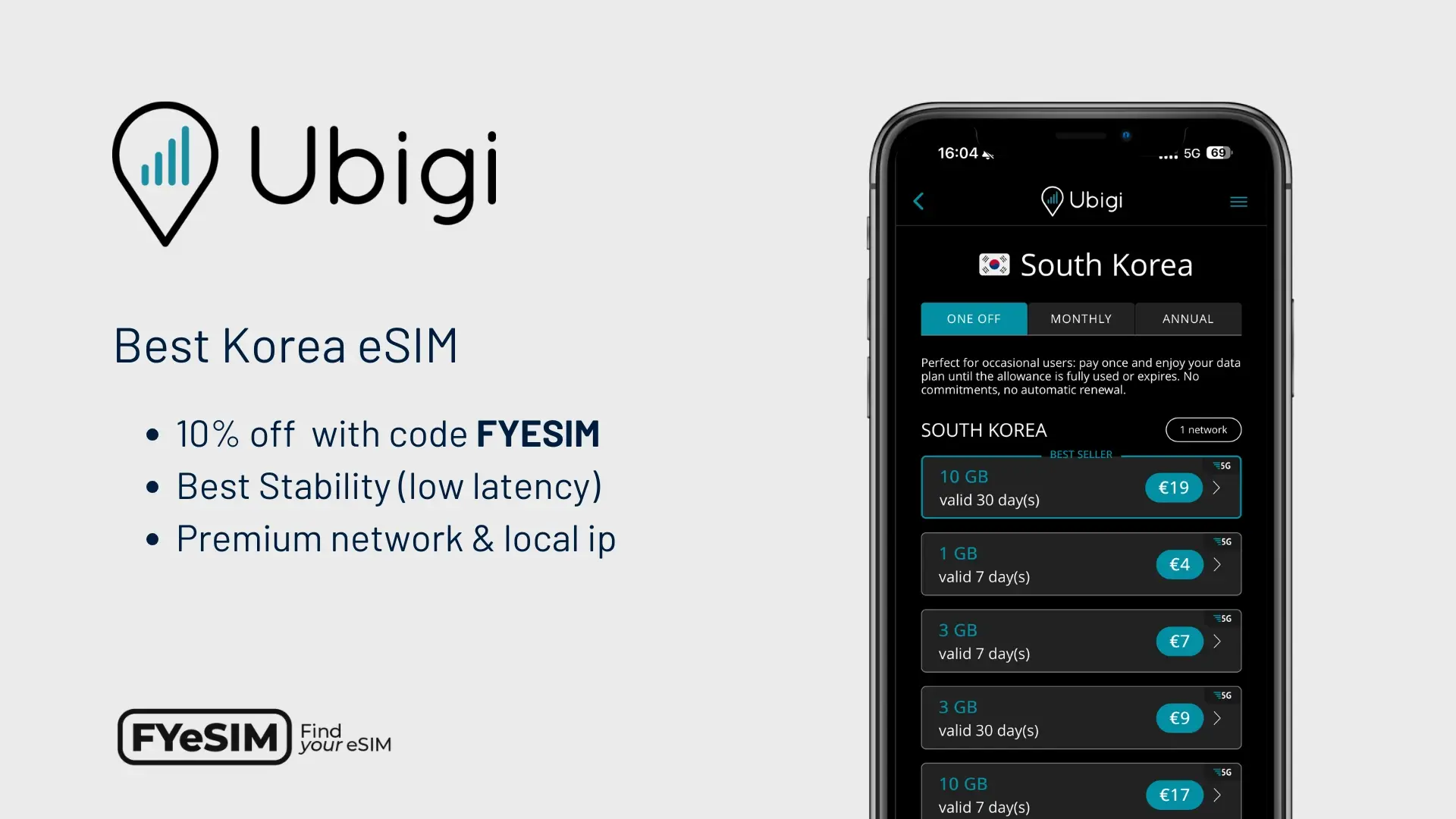
In terms of ease of use, value for money and stability, Ubigi was the absolute standout for me in Korea.
You can get 10% off your Ubigi eSIM with code FYESIM10.
Why Ubigi performed best in my tests:
- Impressive speeds: I recorded 238 Mbps down and 123 Mbps up, essentially like having high-speed fiber broadband in your pocket.
- Truly local connection: Unlike competitors that route data through China or Singapore, Ubigi uses a local Korean data centre to handle traffic directly.
- Zero lag: Since your data doesn't have to travel to another country and back, local apps like Naver Maps and KakaoTaxi respond instantly.
- Superior stability: This local infrastructure keeps your connection smooth and reliable, performing exactly like a local Korean SIM card.
During my stay in Seoul, Ubigi was the eSIM I used personally. It made a real difference for evening video calls home, and the local connection meant Korean apps performed much better. Ubigi offers plans ranging from 13 GB to unlimited, starting from just a few dollars. If you only need a basic connection for WhatsApp and light browsing you might find something cheaper elsewhere, but for anything more I wholeheartedly recommend it.
Ubigi: Pros
- Genuinely local Korean IP and routing (via SK Telecom), no international detour
- Zero lag on local apps like Naver Maps and KakaoTaxi
- Strong, stable speeds (238 Mbps down, 123 Mbps up)
- Plans from 13 GB up to unlimited
Ubigi: Cons
- Not the cheapest if you only need WhatsApp and light browsing
Featured Ubigi plans for South Korea
-
 Ubigi SOUTH KOREASouth Korea only5GData10 GBValidity7 days$12.00$10.80$1.08/GB$12.00$1.20/GB−10% with code
 - Ubigi SOUTH KOREASouth Korea only5GData25 GBValidity30 days$25.00$22.50$0.90/GB$25.00$1.00/GB−10% with code
Saily: Fastest speed
If you want an eSIM with a great app and no issues with geo-restrictions, Saily is an excellent choice. You can also get 10% off with code FYESIM.
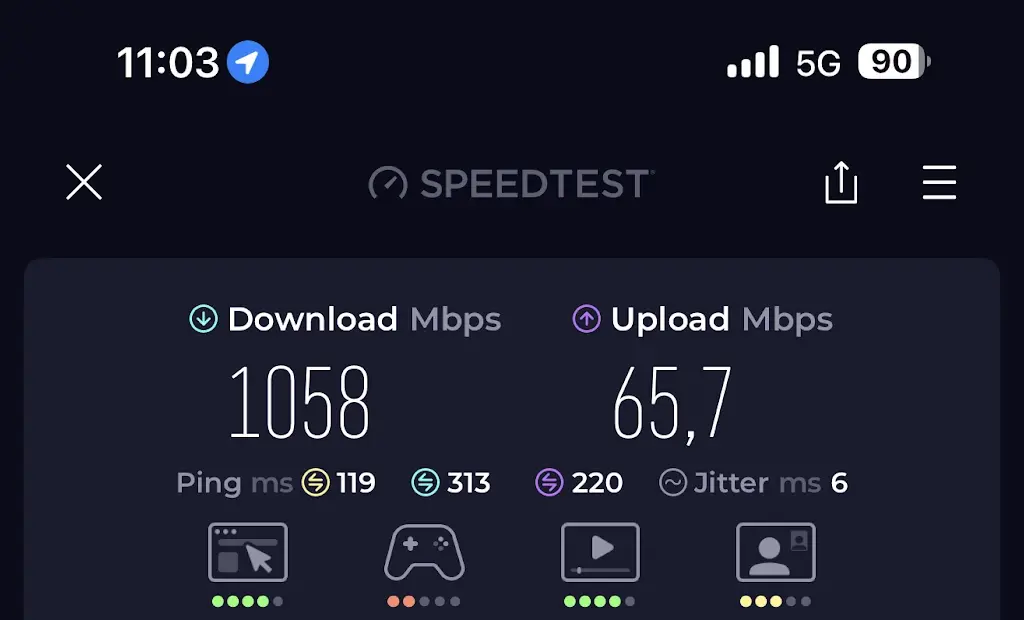
Saily stood out to me for two main reasons. First, it delivered the fastest download speeds of all the providers I tested in Korea. At 1058 Mbps it was more than 30 times faster than Holafly, and that's not a typo. You don't need those speeds for everyday use, since anything above 100 Mbps is already plenty, but it shows Saily isn't cutting corners on quality in Korea.
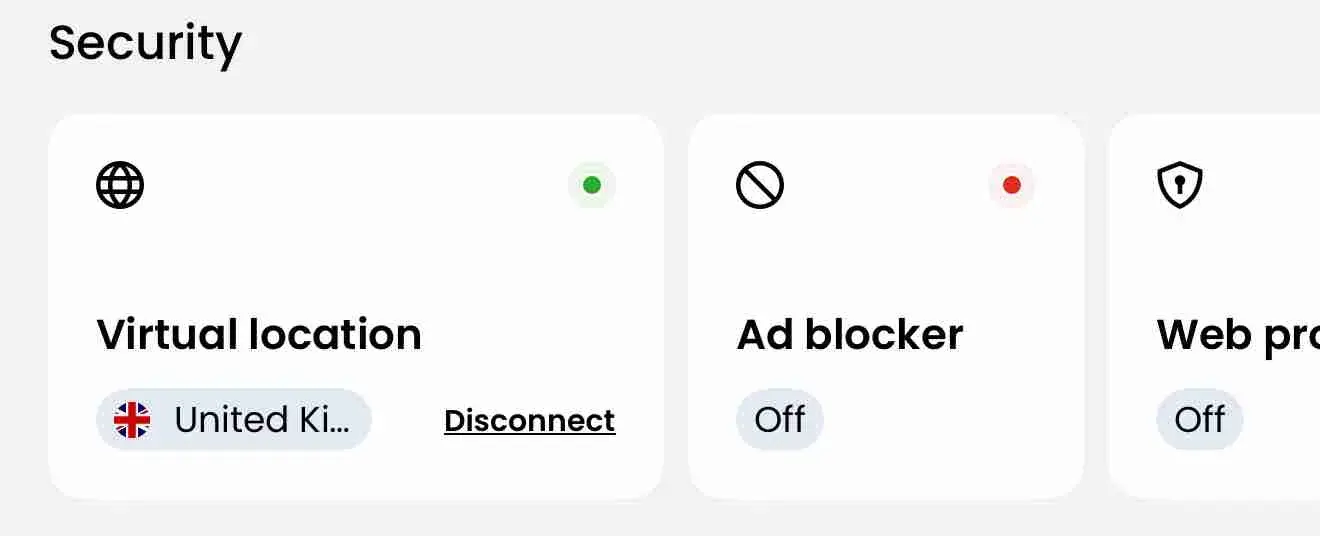
The second advantage is the app. Saily is made by the team behind NordVPN, and their expertise really shows. You can change the virtual location of your eSIM in the app, ideal if you want to watch something from home or switch to a local Korean IP for the best access to local services.
The default routing runs through Hong Kong and was stable during my trip. Video calls were mostly smooth, with only the occasional minor hiccup.
Saily: Pros
- Fastest download speeds in my Korea tests (over 1 Gbps)
- Excellent app with virtual location control, made by the NordVPN team
- Switch between a Korean IP and a home IP for geo-restricted content
- Stable routing for everyday use
Saily: Cons
- Data routes via Hong Kong, so some latency is still noticeable on video calls
Featured Saily plans for South Korea
-
 Saily South KoreaSouth Korea onlyData5 GBValidity30 days$10.99$9.89$1.98/GB$10.99$2.20/GB−10% with code
 - Saily South KoreaSouth Korea onlyData20 GBValidity30 days$29.99$26.99$1.35/GB$29.99$1.50/GB−10% with code
Superalink: Budget unlimited
I've always been slightly hesitant about unlimited data plans. But they can be a good choice when the terms are clear and transparent.
If you don't mind a 5 GB daily limit, then Superalink offers excellent value. You can get 18% off your eSIM with code FYESIM.
Anyone searching for unlimited data will inevitably come across Holafly thanks to its strong online presence. That said, checking an independent comparison really pays off. When I tested, Supera Link provided a faster eSIM with a more transparent fair use policy for about half the price:
- Measured speed: Holafly 34.9 Mbps down vs Supera Link 139 Mbps down
- Fair use policy: Holafly is unclear (it recently removed a FAQ note mentioning 90 GB per month, roughly 3 GB per day, and the policy remains vague), while Supera Link states a clear 5 GB per day
- IP address: Holafly China and Singapore vs Supera Link Singapore
- Price (15 days): Supera Link is around half the price of Holafly for the same period
Both use the same international partner (China Mobile Roaming) to deliver the service, so you might expect similar results, but in my tests the difference was clear. Supera Link delivered 139 Mbps almost immediately, with a clearer and more generous fair use policy, so you get more and faster data for your money.
Supera Link is still a budget option. It was much faster than Holafly during my trip, but it didn't reach the performance of premium brands like Ubigi or Saily. The lower price reflects that, and WhatsApp calls and Naver Maps worked without any issues during my stay.
Superalink: Pros
- Transparent 5 GB per day fair use policy
- Much faster than Holafly in my tests (139 vs 34.9 Mbps)
- Around half the price of Holafly
Superalink: Cons
- Doesn't reach the performance of premium brands like Ubigi or Saily
- Routes via Singapore
Featured Superalink plans for South Korea
-
 Superalink South KoreaSouth Korea onlySouth Korea only
Up to 1 GB per day
Fair-use policy based on information we automatically receive from the provider every 24 hours.
What's this?
Unlimited plans almost always apply a fair-use or data policy: speeds may be reduced after a high-speed allowance. Sometimes providers also throttle the speed from the start. Check the provider's terms before buying. We recommend caution if a provider doesn't clearly communicate its policy during checkout.
DataUnlimitedValidity5 days$2.39$1.96$2.39−18% with code - Superalink South KoreaSouth Korea onlySouth Korea only
Up to 1 GB per day
Fair-use policy based on information we automatically receive from the provider every 24 hours.
What's this?
Unlimited plans almost always apply a fair-use or data policy: speeds may be reduced after a high-speed allowance. Sometimes providers also throttle the speed from the start. Check the provider's terms before buying. We recommend caution if a provider doesn't clearly communicate its policy during checkout.
DataUnlimitedValidity15 days$6.70$5.49$6.70−18% with code
All eSIM test results for Korea
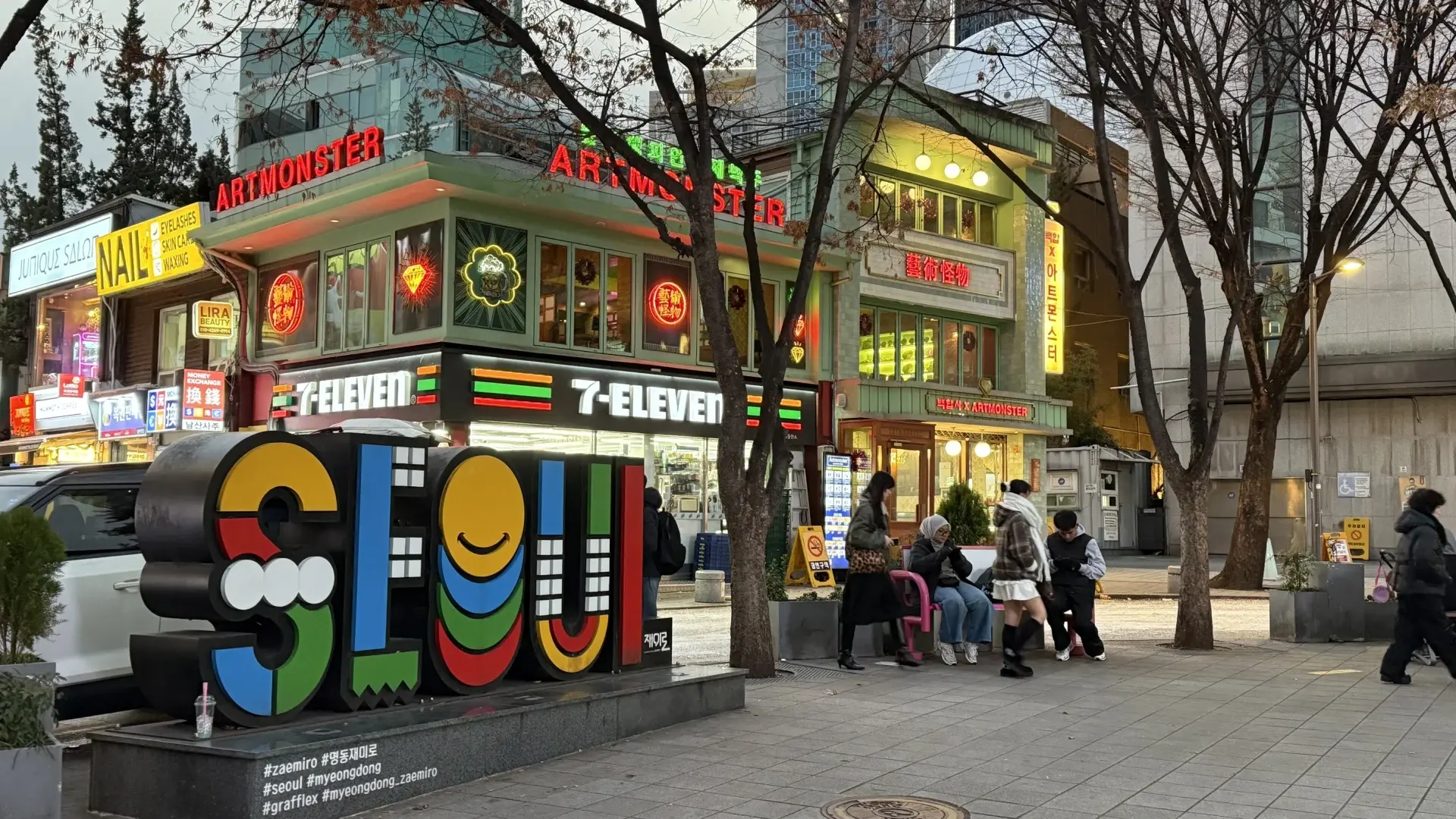
All tests were conducted in Myeongdong, Seoul, under identical conditions using an iPhone 16 Pro in December 2025. I made sure every test was carried out with the best possible signal strength.
For me, Ubigi stood out for stability thanks to its local data handling. Saily was the fastest provider, with the big advantage of letting you choose your own virtual location. I only noticed a significant speed cap with Holafly; otherwise there were no real outliers.
Most eSIMs used servers in Hong Kong or Singapore. This is a form of roaming where your data is routed through another country. Since these locations are relatively close to South Korea, the connection felt perfectly fine. Ubigi was a welcome exception, handling data locally in Seoul.
Firsty, however, had a notable drawback: its data roamed via Africa (Mauritius). Because the signal had to travel such a huge distance, it caused a significant delay (latency). This made video calling and VoIP particularly difficult, with noticeable lag during conversations.
| Provider | Speeds (Mbps) | Stability | Routing |
|---|---|---|---|
| Ubigi | 238 ↓ / 123 ↑ | Excellent. Very responsive; ideal for browsing, streaming, VoIP and real-time apps. | South Korea (local routing) |
| Airalo (짱 Jjang plan) | 933 ↓ / 63 ↑ | Fair to good. Very fast, but latency makes video calls and real-time tasks feel less direct. | Singapore (remote routing) |
| Holafly | 34 ↓ / 19 ↑ | Fair. Works for casual use; video calls may show clear delay; overall the slowest of the tested options. Some popular apps had restricted access when Holafly used a Chinese IP. | China (Shanghai) / Singapore, switching between both (China Mobile Roaming) |
| Voye Global | 701 ↓ / 127 ↑ | Fair to good. Great speeds; slight delay in video calls and real-time communication. | Singapore (remote routing) |
| Saily | 1058 ↓ / 65 ↑ | Good. Excellent throughput; latency still noticeable during calls. You can change the IP in the app. | Hong Kong (remote routing) |
| Firsty | 926 ↓ / 84 ↑ | Fair. Plenty of speed, but noticeable delay with video calls or live apps because of African routing. | Mauritius (remote routing) |
| Three Hong Kong (via MobiMatter) | 110 ↓ / 52 ↑ | Fair to good. Fine for browsing and messaging; latency present in calls. | Hong Kong (remote routing) |
| Supera Link | 139 ↓ / 19 ↑ | Fair. Browsing is fine; video calls slightly impacted by latency. | Singapore (remote routing) |
| Pingwe | 56 ↓ / 53 ↑ | Fair. Browsing is smooth, but latency remains high for calls. | Hong Kong (remote routing) |
| Jetpac | 484 ↓ / 139 ↑ | Fair to good. Good speeds overall; real-time communication feels delayed. | Singapore (remote routing) |
| Truely | 751 ↓ / 87 ↑ | Fair to good. Strong speeds, but latency limits responsiveness. | Singapore (remote routing) |
All providers were personally tested by me in December 2025 under identical conditions, with an iPhone 16 Pro in Myeongdong, Seoul, with the best possible signal strength. Routing (which country the data passes through) is listed too, but providers can change this at any time.
Local networks in South Korea
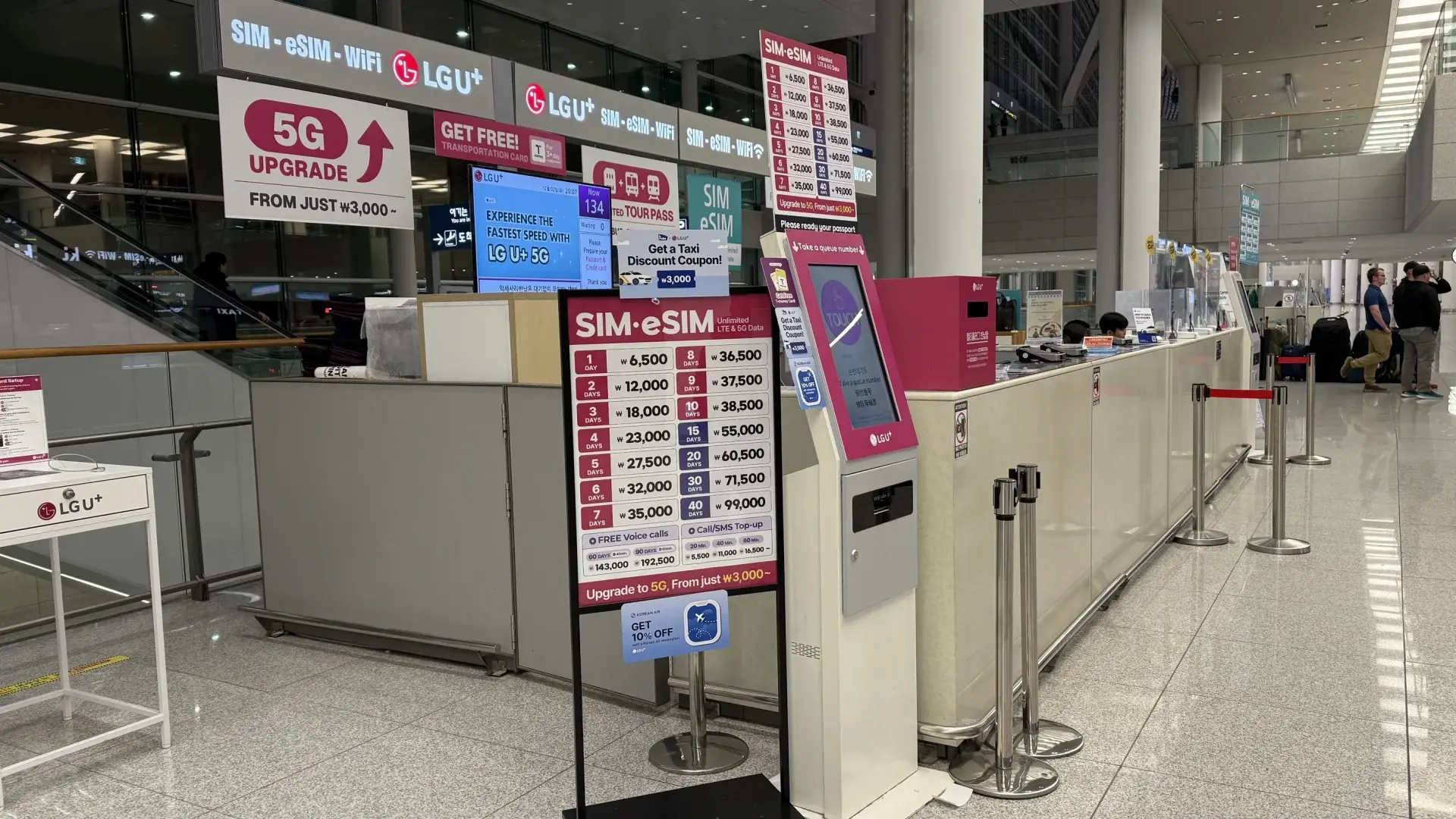
These are the major mobile networks in Korea:
- SK Telecom (SKT)
- KT
- LG U+
Korea has one of the most advanced mobile infrastructures in the world. In cities such as Seoul and Busan the difference between networks is so small that most travelers won't notice anything at all. Coverage and speeds are excellent almost everywhere, and while 5G is widely available in urban areas, 4G and LTE still provide the broadest nationwide reach.
For travelers, your eSIM choice rarely affects basic coverage. All reputable providers connect you to a strong local network, and in the cities it genuinely makes no difference. The main variations you'll notice come from international routing or provider-specific limitations, not from the Korean networks themselves.
That said, 5G access and connection quality still depend on the roaming agreements your eSIM brand has in place. In my tests, Ubigi and Saily performed best overall, offering the strongest combination of speed, stability and everyday usability. If you prefer a remote plan, Ubigi has an extra advantage as it operates through SK Telecom, Korea's most established and consistently high-performing network.
Final thoughts
Roaming costs can add up quickly in South Korea. A travel eSIM is a smart way to avoid these costs and make your trip to Korea much smoother.
While South Korea has an advanced mobile infrastructure, my tests showed that routing makes a real difference. Ubigi offered a local connection for apps like Naver Maps, while Saily delivered the fastest download speeds of over 1 Gbps.
To sum up, here are my top picks for South Korea:
Alternatively, compare 45+ providers yourself using our Korea eSIM comparison tool. It's best to buy and install your eSIM before you depart, so you land fully connected.

Founder of Find Your eSIM. An avid traveller with roots in telecom, he works fully remote and has been hands-on testing travel eSIMs since 2023. He only recommends providers he'd use himself.